
 Cart (0 items)





Manage first tee nerves: Master first tee nerves with proven breathing, visualization, and routine techniques. Calm your mind, control your swing, and.
How to Manage First Tee Nerves: A Golfer's Guide

Table of Contents
- Why First Tee Nerves Happen
- Develop a Pre-Shot Routine for Consistency
- Control Your Breathing and Physiological Arousal
- How to Improve Golf Focus Under Pressure
- Use Visualization and Mental Commitment Techniques
- CBD for Golf Performance and Nerve Management
- Recovery and Post-Shot Mental Reset
- Frequently Asked Questions
Last Updated: September 2, 2026
Why First Tee Nerves Happen
The opening drive is where golf gets psychological. Your heart rate climbs, grip pressure tightens, and the smooth swing you practiced on the range suddenly feels foreign. This isn't weakness, it's your nervous system responding to perceived pressure. Understanding why first tee nerves happen is the first step toward managing them effectively.
When you step up to the tee box in front of other golfers, your body triggers a fight-or-flight response (peer-reviewed research). Adrenaline floods your system. Blood vessels constrict. Muscles tense. Your breathing becomes shallow. This physiological arousal was useful for our ancestors facing predators, but it sabotages golf. Your fine motor control deteriorates. Your tempo accelerates. The shot that felt routine becomes unpredictable.
The mental component compounds the physical one. You're hyper-aware of being watched. You're thinking about the score you're about to post. You're replaying yesterday's poor opening drive. Your internal dialogue turns critical instead of supportive. This outcome-oriented thinking, fixating on what could go wrong, is the enemy of performance. It pulls your attention away from the process: the target, the setup, the swing itself.
Back 9 Botanicals recognizes that managing first tee nerves requires addressing both the body and the mind. Many golfers try to fight the nerves through willpower alone. That rarely works. The better approach is to build systems, a pre-shot routine, breathing techniques, mental frameworks, that work with your physiology instead of against it.

Develop a Pre-Shot Routine for Consistency
A pre-shot routine is your anchor. It's a repeatable sequence of actions that grounds you in the present moment and bypasses the noise in your head. The routine doesn't eliminate nerves, but it channels them into productive focus.
Your pre-shot routine should be simple enough to execute under pressure and specific enough to matter. Most effective routines follow this structure:
-
Stand behind the ball (15-20 seconds), Pick your target. Visualize the shot you want to hit. Take one practice swing if it helps. This is your planning phase.
-
Step into your stance (10-15 seconds), Build your grip and posture. Make micro-adjustments until everything feels aligned. This is your setup phase.
-
Take a breath and commit (5 seconds), One deep breath. Then commit fully to the shot. No second-guessing. No last-minute swing thoughts.
-
Execute, Trust the routine. Trust your swing.
The power of a consistent pre-shot routine is that it works mechanically. Your brain doesn't have to think about what comes next, the routine does that for you. This reduces the mental load and leaves your conscious mind free to focus on the target and the swing itself, not the pressure.

A common mistake is making your routine too elaborate. Golfers add extra steps, extra visualizations, extra swing thoughts. Then under pressure, they rush through it or skip parts entirely. Your routine should be short enough that you can execute it identically on your opening drive and your eighteenth hole, whether you're leading or trailing.
Commit to your routine for at least 20 rounds before you judge whether it works. The first few times feel mechanical. That's normal. By round ten, it becomes automatic. By round twenty, it's a genuine anchor that calms your nervous system before the shot.
Control Your Breathing and Physiological Arousal
Breathing is the fastest way to manage your nervous system. When you're nervous, your breathing becomes shallow and rapid. Your heart rate climbs. Your muscles tighten. Reversing this pattern, slowing and deepening your breath, signals safety to your body (the NIH). Your heart rate drops. Your muscles relax. Your grip pressure normalizes.
The most effective breathing technique for the tee box is the 4-2-4 pattern:
- Inhale for 4 counts, Breathe in slowly through your nose
- Hold for 2 counts, Pause at the top of the breath
- Exhale for 4 counts, Breathe out slowly through your mouth
Perform this sequence once or twice while you're standing behind the ball, before you step into your stance. This single breath cycle activates your parasympathetic nervous system, your body's natural calming mechanism. Your heart rate stabilizes. Your muscles release tension. Your mind becomes clearer.

Beyond breathing, pay attention to grip pressure. Many golfers unconsciously tighten their grip under pressure. A tight grip restricts your swing and increases tension throughout your arms and shoulders. Your grip should feel firm enough to control the club but loose enough that someone could pull the club from your hands with moderate effort (peer-reviewed research). Test this: if your forearms are visibly tense, your grip is too tight.
Another physiological signal is your shoulders. Tension accumulates here first. Before your shot, do a quick shoulder roll, one backward rotation of both shoulders. This releases accumulated tension and reminds your body to stay relaxed. It's a small movement, but it works.
How to Improve Golf Focus Under Pressure
Focus under pressure is a skill, not an accident. It improves with deliberate practice and the right mental framework.
The key distinction is process-oriented thinking versus outcome-oriented thinking. Outcome-oriented thinking fixates on the result: "I need to make a good shot" or "I can't hit it in the water." This thinking increases anxiety because the outcome isn't fully under your control. Process-oriented thinking focuses on what you can control: your target, your setup, your swing tempo, your commitment.
Before each shot, ask yourself: "What is my target?" Not "What score do I need?" or "What could go wrong?" Just the target. Pick a specific spot, not "the fairway" but a tree, a divot, a patch of grass. This specificity anchors your attention and makes your brain work on the shot instead of the pressure.
Once you've identified your target, commit to it completely. Commitment is underrated in golf. Doubt and commitment cannot coexist. The moment you step into your stance, the decision is made. You're hitting that shot to that target with that swing. This mental clarity, the absence of doubt, is what separates confident golfers from anxious ones.
A practical tool is the focus cue. This is a single word or short phrase you say to yourself before executing. Examples: "Smooth," "Target," "Trust," "Now." Say it once, silently or aloud, as you begin your swing. This cue occupies your conscious mind with something productive instead of leaving it free to generate self-doubt.
Use Visualization and Mental Commitment Techniques
Visualization is mental rehearsal. Before you hit the shot, you've already hit it in your mind. You've seen the flight, felt the swing, experienced the result. This primes your nervous system and builds confidence. staying clear under pressure.
Your visualization should be specific and sensory. Don't just see the ball flying, feel the club in your hands, hear the contact, sense the rhythm of your swing. The more senses you engage, the more real the visualization becomes to your brain. Your nervous system doesn't distinguish between a vividly imagined shot and a real one. Both register as experience.
Effective visualization happens behind the ball, during your pre-shot routine. Spend 10-15 seconds seeing the shot you want to hit. Then step into your stance and execute. The visualization primes your motor cortex. Your body knows what to do because you've already done it mentally.
Mental commitment goes deeper than just deciding to hit the shot. It's accepting that the outcome might not be perfect and committing anyway. This is where many golfers stumble. They commit only if they're confident the shot will be good. But commitment under uncertainty is what separates performance under pressure from performance in practice.
Before your opening drive, commit to this: "I'm hitting this shot with full commitment. The result might not be perfect, and that's okay. I'm executing my routine and trusting my swing." This acceptance paradoxically improves performance. When you stop demanding perfection, you relax. When you relax, you swing better.
CBD for Golf Performance and Nerve Management
Managing first tee nerves isn't just about mental techniques and breathing. Your body's state matters. Many golfers find that supporting their nervous system with targeted supplements helps them stay calm and focused.
This is where hemp-derived CBD comes in. CBD interacts with your endocannabinoid system, which regulates stress response, muscle tension, and focus. For golfers dealing with first tee jitters, CBD can help reduce physiological arousal, the racing heart, the tight muscles, the shallow breathing, without impairing your swing mechanics or decision-making.
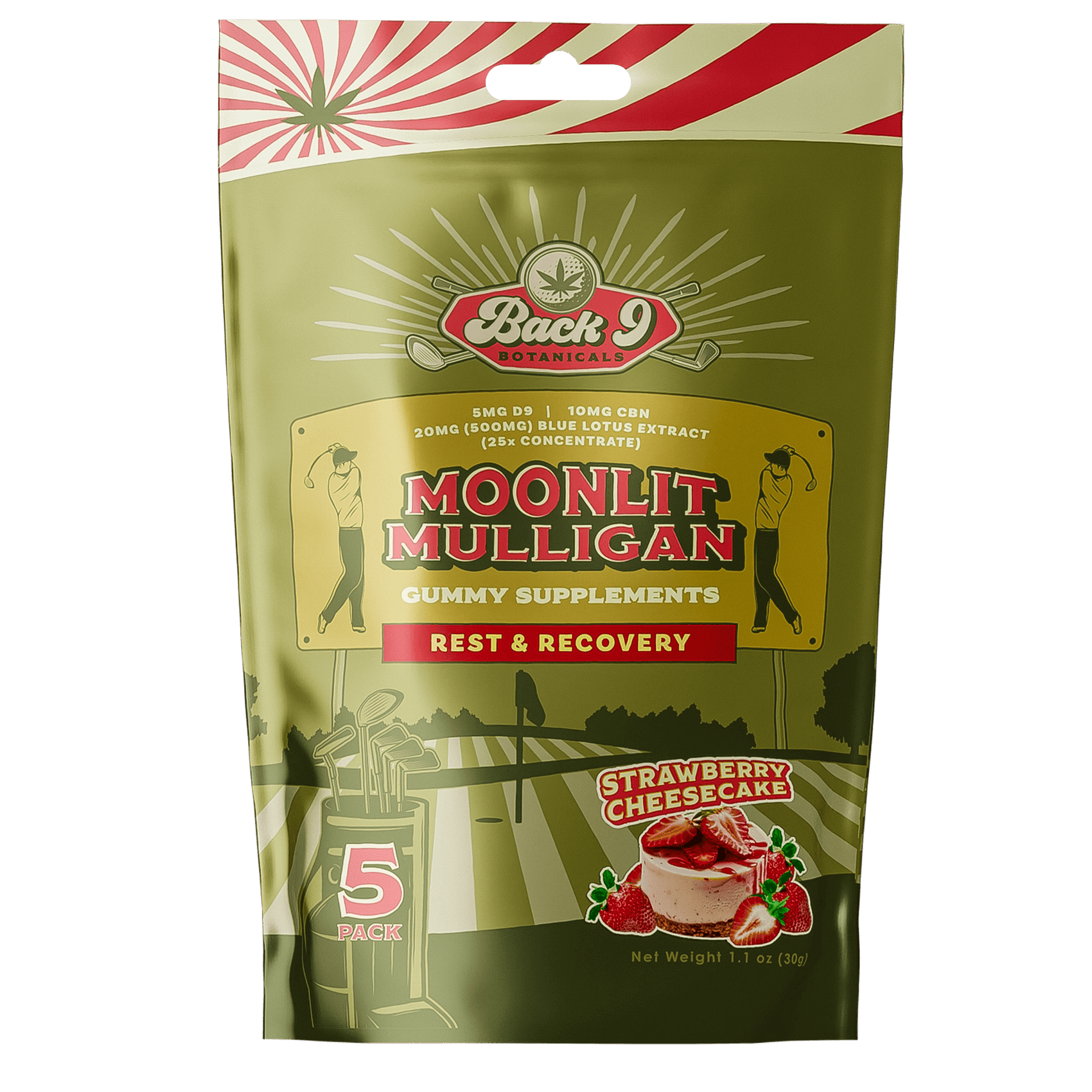
Back 9 Botanicals designed their Players Blend Energy & Focus Gummies specifically for golfers who need mental clarity and calm before their round. Each gummy contains a micro-dose of hemp-derived Delta 9 THC paired with natural botanicals like L-citrulline and caffeine. The combination supports focus and energy without the anxiety spike that caffeine alone can cause. Many golfers take one gummy 30-45 minutes before their tee time and notice a meaningful difference in how calm and committed they feel over the opening holes.
For golfers who prefer a more comprehensive approach, the [Back 9 Daily Wellness Stack(/products/the-back-9-daily-wellness-stack) | back9botanicals.com] combines three formulas: Birdie Boost for daily balance and attitude, Players Blend for pre-round focus, and Moonlit Mulligan for post-round recovery. This stacked approach addresses the full golf day, from managing pre-round nerves to supporting recovery after your round.
The key is consistency. CBD works best when you use it regularly, not just on tournament days. This allows your endocannabinoid system to regulate more effectively. Many golfers report that after two to three weeks of consistent use, they notice they're naturally calmer on the tee box, even without the supplement. The CBD helps your nervous system recalibrate.
One practical consideration: start with a lower dose and adjust based on how you feel. Everyone's endocannabinoid system is slightly different. A dose that works for your playing partner might be too much or too little for you. Back 9 Botanicals products are dosed to be accessible for beginners while still effective for experienced users.
Recovery and Post-Shot Mental Reset
Your mental game doesn't end when you finish your shot. How you respond to the result, whether it's good or poor, shapes your mental state for the next hole.
After a good shot, the instinct is to replay it mentally and feel good about it. That's fine for 10 seconds. Then let it go. Dwelling on good shots creates complacency and false confidence. You need to reset and prepare for the next challenge.
After a poor shot, the instinct is to get angry, replay what went wrong, and carry the frustration to the next tee. This is the worst possible response. A poor shot is information, not a referendum on your abilities. Extract the lesson, "My tempo was too fast" or "I didn't commit fully", then release it.
A post-shot reset technique is simple: take one deliberate breath after every shot, good or bad. This breath signals to your nervous system that the previous shot is complete. Your focus returns to the present moment. You're ready for the next shot.
Another technique is the reset walk. Between shots, focus on your surroundings instead of the previous shot. Notice the grass, the trees, the other golfers. This grounds you in the present and interrupts the mental loop of replaying the last shot.
Many golfers find that post-round recovery supports their mental reset. After 18 holes, your nervous system has been activated repeatedly. Supporting recovery, through stretching, hydration, and supplements like Back 9 Botanicals' recovery formulas, helps your body return to baseline. This makes the next round easier because you're starting from a calmer, more recovered state.
Managing first tee nerves is a learnable skill. It requires a system: a pre-shot routine that anchors your focus, breathing and physiological techniques that calm your nervous system, mental frameworks that keep you process-oriented, and tools like visualization that prime your brain for success. Many golfers discover that adding targeted nutritional support, like the hemp-derived formulas from Back 9 Botanicals, creates meaningful improvements in their ability to stay calm and committed under pressure. Get started with Back 9 Botanicals' Performance Canna+ Gummies Bundle and experience how the right combination of routine, technique, and support can transform your opening drive from a source of anxiety into a moment of focus and confidence.
Frequently Asked Questions
How can I calm my nerves on the first tee?
Start with a consistent pre-shot routine that includes deep breathing, target commitment, and a clear focus cue. Take 3-4 deep breaths to lower your heart rate, then visualize your ideal shot before stepping into your stance. Grip pressure should be relaxed, not tight, tension amplifies jitters. Many golfers find that repeating a simple internal dialogue or mantra helps anchor their focus away from outcome anxiety and onto the process.
What role does CBD play in managing golf performance anxiety?
CBD interacts with your body's endocannabinoid system to promote relaxation without impairing focus or swing mechanics. Many golfers use CBD products like Back 9 Botanicals' formulas before rounds to reduce physiological arousal, lower heart rate and muscle tension, while maintaining mental clarity. The key is finding your optimal dose; start with a lower amount and adjust based on how your body responds. Always verify that any hemp-derived product complies with your tournament rules.
How long does it take to build an effective pre-shot routine?
Most golfers see improvement within 2-3 weeks of consistent practice on the range and in casual rounds. Your routine should take 20-30 seconds total and include breathing, target selection, alignment, and a final confidence cue. Repetition builds automaticity, the more you practice it without pressure, the more reliably it will work under tournament stress. Course management and rhythm matter too; rushing your routine undermines its effectiveness.
Can I use hemp-derived THC products and still compete in amateur tournaments?
Rules vary by tournament and governing body. The USGA and PGA Tour have specific policies on hemp-derived cannabinoids; some allow CBD-only products while others restrict any THC. Before using any Back 9 Botanicals product containing Delta 9 THC, verify the rules of your specific event or league. Always check current regulations, as policies continue to evolve. When in doubt, contact your tournament organizer directly.
This article was written using GrandRanker

