
 Cart (0 items)





Does CBD show on drug tests? Learn how THC metabolites trigger positives, which products are safest, and how to protect yourself. Read the full guide.
Does CBD Show on Drug Tests? What You Need to Know

Table of Contents
- What CBD Drug Tests Actually Detect
- Full Spectrum vs Isolate CBD Drug Test Risk
- How Long Does CBD Stay in Your System
- CBD Oil and DOT Drug Testing Rules
- How to Read a Certificate of Analysis Before You Buy
- What to Do If CBD Triggers a Positive Drug Test Result
- Conclusion
Last Updated: August 26, 2026
What CBD Drug Tests Actually Detect
Does CBD show on drug tests? The short answer is: CBD itself is not what triggers a positive result. Standard workplace drug screening tests are not designed to detect cannabidiol. They are built to detect THC metabolites, specifically the compound your body produces when it processes delta-9-tetrahydrocannabinol.
This distinction matters enormously, and it's the part most guides bury in paragraph six.
At Back 9 Botanicals, we hear this question constantly from golfers and athletes who want the recovery and focus benefits of hemp-derived cannabinoids without jeopardizing their standing at work or in competition. Understanding exactly what gets tested, and why, is the foundation for making a smart decision.
CBD vs. THC: Why the Difference Matters
CBD (cannabidiol) is a non-psychoactive compound found in hemp plants. It does not produce intoxication, and standard drug tests do not screen for it.
THC (delta-9-tetrahydrocannabinol) is the psychoactive compound in cannabis. When your body metabolizes THC, it produces a compound called THC-COOH, which binds to fat tissue and is released gradually over time. That metabolite is what urinalysis and other drug screens are looking for.
The problem is not CBD. The problem is THC content in the CBD product you're using.
How Urinalysis and Confirmatory Testing Work
Most workplace drug screening programs use a two-step process. The first step is an immunoassay, a rapid urine test that flags samples containing THC metabolites above a specific cut-off level. The standard cut-off for federal workplace testing is 50 nanograms per milliliter, as established by SAMHSA federal workplace drug testing guidelines.
If a sample triggers the immunoassay, a second confirmatory test follows. Gas chromatography-mass spectrometry (GC-MS) is the confirmatory method, and it is far more precise. GC-MS can identify specific compounds and their concentrations, which is why a false positive from the immunoassay can sometimes be cleared at confirmation, though not always.
The key takeaway: even trace amounts of THC, accumulated over time through repeated CBD product use, can push THC metabolite levels above the cut-off threshold.
Full Spectrum vs Isolate CBD Drug Test Risk
The type of CBD product you choose is the single biggest variable in your drug test risk. This is where most people make a costly mistake.
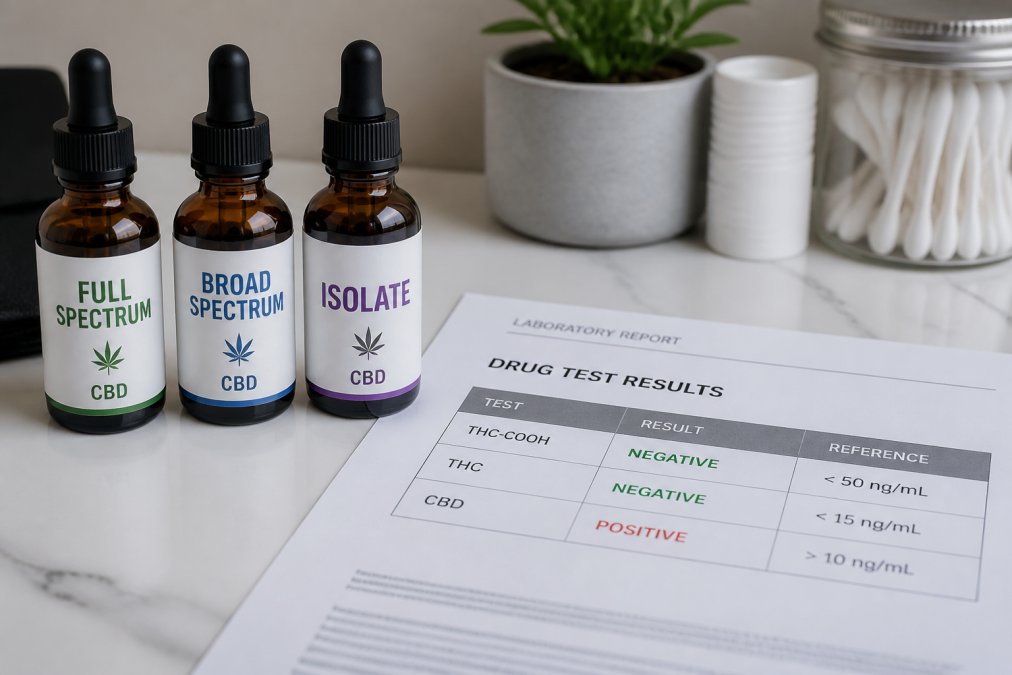
Full-spectrum extract contains the complete cannabinoid profile of the hemp plant, including CBD, minor cannabinoids, terpenes, and THC. Under the 2018 Farm Bill, hemp-derived products may legally contain up to 0.3% delta-9-THC by dry weight, as documented by USDA hemp production regulations. That sounds like a negligible amount. For occasional users, it probably is. For daily users taking higher doses, that trace THC accumulates in fatty tissue, and systemic absorption over weeks can push metabolite levels into detectable territory.
CBD isolate is the opposite: a purified form of cannabidiol with all other cannabinoids, including THC, removed. Isolate carries the lowest drug test risk because there is no THC to metabolize. The trade-off is that isolate lacks the entourage effect, the synergistic interaction between cannabinoids and terpenes that many users find enhances overall effectiveness.
Broad-Spectrum: The Middle Ground
Broad-spectrum products occupy the space between full-spectrum and isolate. They retain most cannabinoids and terpenes but undergo additional processing to remove THC. A well-manufactured broad-spectrum product should test at non-detectable THC levels.
The word "should" is doing a lot of work in that sentence. Quality control varies dramatically across the industry, and broad-spectrum products from less rigorous manufacturers can still contain trace THC. This is not a reason to avoid broad-spectrum entirely. It is a reason to verify the certificate of analysis before you buy, which we cover in detail below.
| Product Type | THC Content | Drug Test Risk | Best For |
|---|---|---|---|
| Full-Spectrum | Up to 0.3% THC | Moderate to High | General wellness, no testing |
| Broad-Spectrum | Non-detectable (varies) | Low (if verified) | Regular use with occasional testing |
| CBD Isolate | Zero THC | Lowest | Frequent testing, DOT-regulated roles |
The Label Accuracy Problem with Unregulated Products
Here is where the full spectrum vs isolate CBD drug test risk conversation gets complicated. The hemp supplement market remains largely unregulated at the federal level. Studies cited by FDA consumer updates on CBD products have found that a meaningful proportion of CBD products contain THC levels inconsistent with their labels, with some products containing significantly more THC than stated.
This is the real risk. You can buy a product labeled "THC-free" that contains enough THC to affect a drug test result. Without third-party testing verification, you are taking the manufacturer at their word.
Watch Out
Never rely solely on a product label for THC content claims. A label that reads "THC-free" or "0% THC" is only as trustworthy as the testing behind it. Always verify with a current certificate of analysis from an independent laboratory.
How Long Does CBD Stay in Your System
How long does CBD stay in your system is a question that actually has two answers: how long CBD itself remains detectable, and how long any THC from your CBD product stays detectable. For drug testing purposes, only the second answer matters.
CBD itself has a relatively short half-life. For most people, CBD clears the system within a few days to a week, depending on dosage, frequency of use, body composition, and metabolism. But again, standard drug tests are not screening for CBD.
THC metabolites are a different story. THC is highly lipophilic, meaning it binds to fat cells, which extends its detection window considerably compared to most other substances.
Detection Windows by Test Type
Detection windows vary significantly by test type, and understanding this is critical for anyone facing workplace drug screening.
| Test Type | Detection Window (Occasional Use) | Detection Window (Daily Use) |
|---|---|---|
| Urine (urinalysis) | 3-7 days | Up to 30+ days |
| Blood | 1-3 days | Up to 7 days |
| Saliva | 24-72 hours | Up to 7 days |
| Hair follicle | Up to 90 days | Up to 90 days |
Urine testing is by far the most common method in workplace drug screening programs. Hair follicle testing has the longest detection window and is most commonly used in pre-employment screening for safety-sensitive roles.
Factors That Affect How Fast THC Clears
Pharmacokinetics, the way your body processes and eliminates compounds, is highly individual. Several factors influence how quickly THC metabolites clear your system:
- Body fat percentage: THC metabolites bind to fat tissue. Higher body fat means longer retention and a longer detection window.
- Frequency of use: Daily full-spectrum CBD users accumulate THC metabolites faster than occasional users. Occasional users may clear within days; daily users can take weeks.
- Dosage: Higher doses mean more THC entering the system, even from low-concentration products.
- Metabolism rate: Faster metabolisms process and eliminate metabolites more quickly.
- Hydration and exercise: Both can influence excretion rates, though neither reliably clears THC fast enough to beat a test on short notice.
Pro Tip
If you know a drug test is coming and you use full-spectrum products, switch to a verified CBD isolate at least 30 days beforehand. Even then, if you have been a heavy daily user, consult an occupational health professional about your specific situation.
CBD Oil and DOT Drug Testing Rules
CBD oil and DOT drug testing is a combination that requires absolute clarity. The Department of Transportation enforces drug and alcohol testing regulations for safety-sensitive transportation workers, including commercial truck drivers, pilots, train operators, and others covered under 49 CFR Part 40.
The DOT position is unambiguous: CBD use is not a valid medical explanation for a positive THC drug test result. According to DOT drug and alcohol testing regulations, a verified positive result for THC metabolites remains a violation regardless of the source of the THC, whether from marijuana, hemp-derived CBD products, or any other cannabis-derived substance.
DOT testing uses urine as the primary specimen type, with the same 50 nanograms per milliliter cut-off for the initial immunoassay and 15 nanograms per milliliter for GC-MS confirmation.
For anyone in a DOT-regulated role, the only genuinely safe option is CBD isolate from a manufacturer that provides batch-specific certificates of analysis confirming non-detectable THC. Even then, understand that the DOT does not recognize CBD use as a defense. The compliance risk is real, and occupational health professionals in transportation-adjacent industries treat it seriously.
Key Takeaway
DOT-regulated employees have zero margin for error. No amount of CBD product use is considered a valid explanation for a positive drug test under federal transportation regulations. If your job is DOT-regulated, consult your employer's drug and alcohol program administrator before using any hemp-derived product.
How to Read a Certificate of Analysis Before You Buy
A certificate of analysis (COA) is the only objective verification that a CBD product contains what its label claims. Every reputable hemp brand publishes COAs for each product batch. If a company does not publish them or cannot produce them on request, stop there.
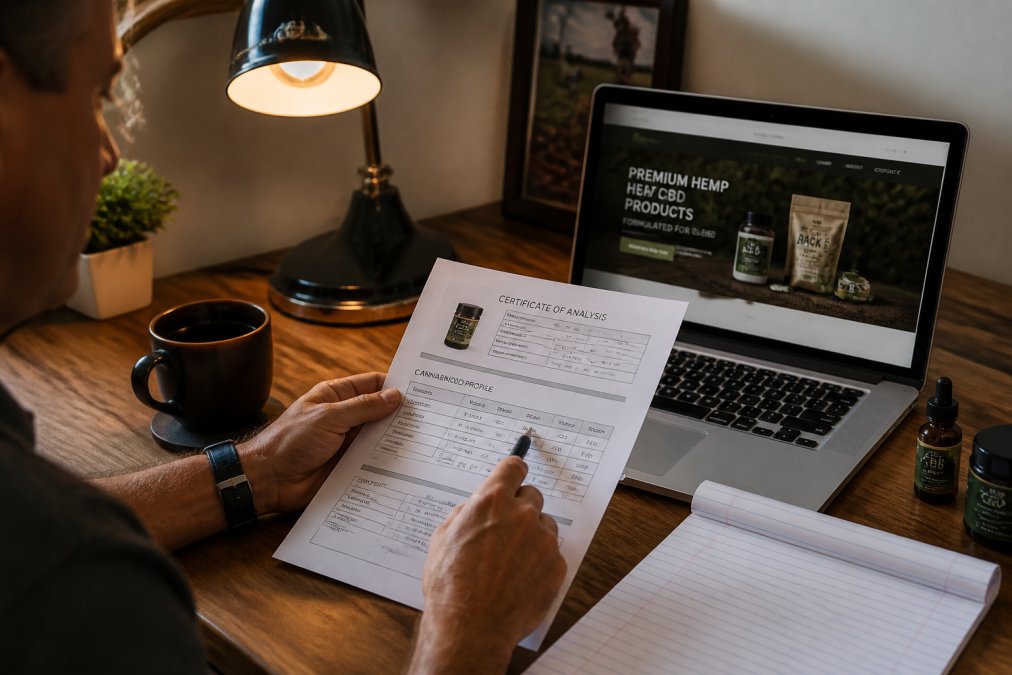
Here is what to look for when reading a COA:
1. Confirm the testing laboratory is independent. The COA should be issued by a third-party laboratory, not the brand's own facility. Look for accreditation markers such as ISO/IEC 17025 certification.
2. Match the batch number. The COA batch number should match the batch number on your product packaging. A COA from six months ago does not verify your current product.
3. Check the cannabinoid panel. This section lists all detected cannabinoids and their concentrations. For isolate products, THC should read "ND" (non-detectable) or below the laboratory's limit of quantitation. For broad-spectrum, THC should also read ND. For full-spectrum, expect a THC reading below 0.3%.
4. Review the potency results. Confirm the CBD content matches what the label claims. Significant discrepancies either over or under-labeled potency are a red flag for quality control problems.
5. Check for contaminant panels. A thorough COA includes testing for heavy metals, pesticides, residual solvents, and microbial contamination. Products that only test cannabinoid content are giving you an incomplete picture.
Back 9 Botanicals publishes lab tests for its products because transparency is not a marketing strategy, it is a baseline requirement. Before purchasing any hemp-derived product, make COA verification a non-negotiable step.
What to Do If CBD Triggers a Positive Drug Test Result
A positive drug test result tied to CBD use puts you in a genuinely difficult position. Here is a practical sequence for responding.
Step 1: Request confirmatory testing immediately. If your initial immunoassay returns positive, you have the right to request GC-MS confirmatory testing. Some false positives from the immunoassay stage do not survive confirmatory testing. Do not waive this right.
Step 2: Preserve your product and the COA. Keep the product you were using and its certificate of analysis. This documentation establishes what you were taking and at what THC concentration.
Step 3: Disclose your CBD use to the Medical Review Officer (MRO). In federally regulated testing programs, a Medical Review Officer reviews confirmed positive results. You can report your CBD use to the MRO as context, though understand that for DOT-regulated roles this explanation does not change the outcome of the result.
Step 4: Consult an employment attorney if your job is at risk. Legal recourse for false positives is limited but not nonexistent. If you can demonstrate that your product contained only trace THC within legal limits, and that the confirmatory result was borderline, an attorney specializing in employment or occupational health law can advise on your specific options. Outcomes vary significantly by employer policy, state law, and the specific circumstances of the result.
Step 5: Adjust your product choice going forward. Whatever the outcome, this is the moment to switch to CBD isolate or a rigorously tested broad-spectrum product with batch-specific COA verification. The risk of repeating this situation is not worth it.
Watch Out
Do not attempt to dilute a urine sample or use detox products marketed to "flush" THC from your system. Specimen validity testing is standard in most programs, and a diluted or adulterated sample is itself a violation under federal testing guidelines.
Understanding does CBD show on drug tests requires separating what drug screens actually detect from the broader category of hemp-derived cannabinoids. CBD itself is not the target. THC metabolites are. The risk comes from THC content in your CBD product, accumulated over time, not from CBD itself.
For golfers, athletes, and active adults who want the genuine recovery and focus benefits that hemp-derived cannabinoids can provide, the answer is not to avoid these products. It is to choose them carefully. Back 9 Botanicals builds its formulas with clean, functional ingredient profiles and publishes lab results because the people using these products deserve to know exactly what they are putting in their bodies. Visit the Back 9 Botanicals website to review current lab tests and find the right formula for your performance and recovery goals.
Frequently Asked Questions
Do standard workplace drug tests screen for CBD?
Standard workplace drug tests screen for THC metabolites, specifically delta-9-tetrahydrocannabinol and its breakdown compound THC-COOH, not CBD itself. CBD is non-psychoactive and has no established cut-off level in occupational health screening panels. The risk comes from CBD products that contain trace amounts of THC. If those traces accumulate over time, they can push THC metabolite levels above the standard 50 nanograms per milliliter threshold used in most urinalysis immunoassay screens.
How long does CBD stay in your system for a drug test?
Pure CBD isolate clears the body quickly and is not detected by standard drug screening. The real concern is residual THC from full-spectrum products. THC metabolites are fat-soluble, so they store in body tissue and release slowly. For occasional users, urine detection windows typically run 3 to 7 days. Daily or heavy users can test positive for 30 days or longer. Blood tests have shorter windows of 1 to 7 days, while hair follicle tests can detect THC metabolites up to 90 days after last use.
Can full-spectrum CBD cause a positive drug test?
Yes, full-spectrum CBD products contain delta-9-tetrahydrocannabinol up to the federal legal limit of 0.3% by dry weight. That trace THC is enough to accumulate in body fat with regular use and trigger a positive result on a urinalysis or confirmatory gas chromatography-mass spectrometry test. The risk increases with higher doses, daily use, and slower personal metabolism. Choosing a third-party tested CBD isolate or verified broad-spectrum product with non-detectable THC levels significantly lowers this risk.
Are there CBD products guaranteed to be THC-free?
No manufacturer can offer a legal guarantee, but CBD isolate products verified by third-party testing with a current Certificate of Analysis showing non-detectable THC are the closest option available. Look for COAs from accredited labs that test to below 0.01% THC and confirm the batch number matches your product. Unregulated products without COAs carry the highest contamination risk. Even broad-spectrum products labeled as THC-free should be confirmed via lab results before use by anyone subject to drug screening.
This article was written using GrandRanker

