
 Cart (0 items)





Learn practical techniques to manage golf performance anxiety. Master breathing, routines, and mental strategies to play your best under pressure.
How to Manage Golf Performance Anxiety

Table of Contents
- Recognizing the Signs of Golf Performance Anxiety
- How to Improve Golf Focus Through Mental Awareness
- Deep Breathing and Progressive Muscle Relaxation Techniques
- Building a Pre-Shot Routine for Consistency
- Setting Process Goals Instead of Outcome Goals
- CBD for Golf Performance and Mental Clarity
- Reframing Pressure and Accepting Nerves
- Frequently Asked Questions
Last Updated: September 26, 2026
Recognizing the Signs of Golf Performance Anxiety
To manage golf performance anxiety effectively, you need to recognize how it shows up differently for every player, though the physical and mental signals are usually unmistakable. Your heart rate spikes on the first tee. Your hands feel shaky. You can't stop replaying that bad shot from last week, even though you're standing over a completely different putt.
Common physical symptoms include tension in your shoulders and neck, shallow breathing, tight chest, increased grip pressure, sweaty palms, and stomach discomfort.
Mentally, performance anxiety often shows up as:
- Racing thoughts about what could go wrong
- Difficulty focusing on the present shot
- Overthinking swing mechanics mid-swing
- Replaying past mistakes instead of moving forward
- Fear of judgment from playing partners
- Negative self-talk ("I always miss these putts")
The spotlight effect, feeling scrutinized even when nobody's watching closely, creates real physiological stress responses in your body.
How to Improve Golf Focus Through Mental Awareness
Improving your mental game starts with self-awareness. Most golfers try to force focus through willpower alone, which rarely works. Instead, develop awareness of your mental state throughout your round, then respond with targeted techniques.
Pay attention to your internal dialogue between shots. Are you replaying mistakes or thinking about your next target? Self-awareness means noticing these patterns without judgment.
Here's a practical approach:
- After each hole, pause and notice your emotional state (calm, frustrated, anxious, confident)
- Track which situations trigger your worst focus (certain hole types, specific playing partners, certain scores)
- Notice when your mind drifts and what it drifts toward
- Identify your personal early warning signs (the specific thoughts or physical feelings that precede poor shots)
One critical dimension most golfers overlook: social context anxiety. Your focus challenges often depend on who you're playing with, not just what you're playing.
Playing with strangers vs. friends creates different anxiety profiles:
- Strangers: You may feel pressure to prove yourself, fear judgment from unknown players, or worry about holding up the group. This often manifests as rushing your pre-shot routine or overthinking to avoid looking incompetent.
- Friends: You might experience different pressure, fear of embarrassment in front of people who know your game, competitive comparison, or pressure to perform at your typical level even on an off day.
- Competitive events: Gallery awareness, scoreboard consciousness, and the spotlight effect intensify. Even amateur tournaments create social pressure that casual rounds don't.
The awareness skill here is recognizing which social context destabilizes your focus. Some golfers play better with strangers because there's no history or expectation. Others play better with friends because the stakes feel lower. Identifying your pattern is the first step.
A practical tracking method:
- Over five rounds, note the composition of your group (strangers, close friends, mixed, tournament setting)
- Rate your focus quality on that round (1-10)
- Note which holes you played best and worst
- Look for patterns: Do you focus better in certain social contexts? Do specific group dynamics (quiet vs. chatty, competitive vs. casual) help or hurt your game?
Once you identify your social anxiety triggers, you can prepare differently. If you play worse with strangers, you might practice more pre-round visualization to build confidence. If you struggle with friends, you might reframe the round as practice rather than performance.
Your focus doesn't need to be perfect, it needs to be appropriate to the moment.
Pro Tip
Track your focus patterns for three rounds, noting the social context of each. Write down one moment per hole where your focus was sharp and one where it wandered. You'll start seeing whether your anxiety is triggered by the game itself or by the social dynamics around it, and that distinction changes how you prepare.
Deep Breathing and Progressive Muscle Relaxation Techniques
When anxiety spikes, your autonomic nervous system shifts into fight-or-flight mode: shallow breathing, muscle tension, elevated heart rate (Checking your browser). Deep breathing reverses this response by signaling your nervous system that you're safe.
- Breathe in through your nose for a count of 4
- Hold the breath for a count of 7
- Exhale slowly through your mouth for a count of 8
- Repeat 3-4 times
Key Takeaway
The best time to practice these techniques is not during your round, it's the night before and the morning of. Build the habit when you're calm, so your nervous system knows the pattern when pressure hits.
Building a Pre-Shot Routine for Consistency
A solid pre-shot routine is one of the most underrated tools to manage golf performance anxiety. It gives your mind something concrete to focus on. Your routine doesn't need to be complicated, it needs to be consistent and purposeful. Familiar patterns feel safe, and safe feels calm.
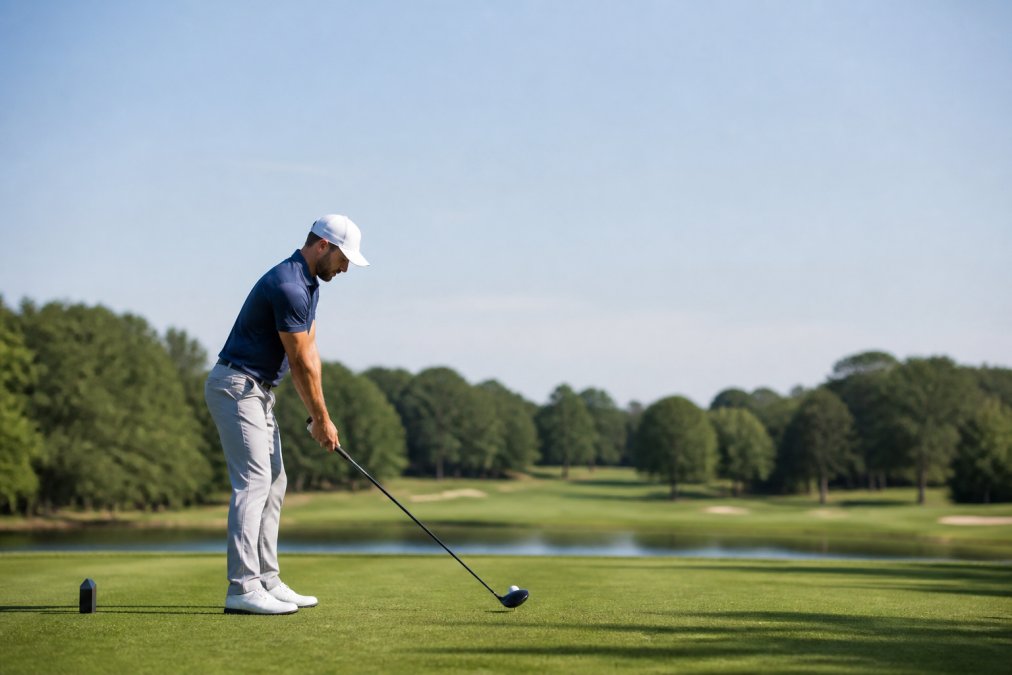
Here's a framework for a pre-shot routine:
- Step 1: Read the shot (30 seconds), Assess distance, wind, slope, and hazards
- Step 2: Pick your target (10 seconds), Commit to a specific line or landing zone
- Step 3: Take your stance (10 seconds), Position your feet and align your body
- Step 4: Final visualization (5 seconds), See the shot playing out successfully
- Step 5: Execute (no thinking), Trust your swing and commit
Watch Out
The biggest mistake is changing your routine under pressure. If you suddenly speed it up or skip steps when you're nervous, you lose the benefit. Commit to your routine and stick with it no matter the stakes.
Setting Process Goals Instead of Outcome Goals
Most golfers fixate on outcome goals: "I need to shoot 78" or "I need to make this putt." The problem is that outcomes depend on factors outside your control, swing mechanics, lie, wind, luck. Focusing entirely on outcomes creates unnecessary pressure.
Here's the difference in practice:
| Goal Type | Example | Why It Matters |
|---|---|---|
| Outcome goal | "Shoot under 80" | Creates pressure; depends on factors outside your control |
| Process goal | "Execute my routine on every shot" | Builds confidence; depends entirely on you |
| Outcome goal | "Make this putt" | Increases anxiety; focuses on result |
| Process goal | "Read the line carefully and commit to my stroke" | Reduces anxiety; focuses on execution |
CBD for Golf Performance and Mental Clarity
CBD and other hemp-derived cannabinoids have become increasingly popular among golfers and athletes seeking natural support for focus, recovery, and mental clarity.
Best For
Golfers seeking natural support for focus and anxiety who want a product specifically formulated for the demands of competitive rounds. Back 9 Botanicals products are designed with golfer-specific needs in mind, combining performance support with recovery focus.
Reframing Pressure and Accepting Nerves
Most performance guides suggest eliminating nervousness, but the real goal is performing well despite the nerves. Elite athletes interpret nerves as excitement rather than fear. Your nervous system produces the same physiological response in both cases, elevated heart rate, heightened focus, increased adrenaline. Your interpretation determines whether it helps or hurts.
Post-Round Mental Recovery: The Missing Piece
What most guides overlook is post-round recovery. A high-anxiety round creates mental fatigue, your nervous system has been elevated for hours and your prefrontal cortex is depleted. Without active recovery, that fatigue compounds your anxiety baseline. Post-round recovery isn't optional; it's part of anxiety management.
Immediate post-round (first 30 minutes):
- Avoid replaying obsessively. Endless replay reinforces negative patterns. Acknowledge the round, note one or two learning points, then move on.
- Shift your nervous system state. Use 5-10 minutes of deep breathing, a short walk, or light stretching to signal safety.
- Separate identity from performance. You had an anxious round; that doesn't mean you are an anxious athlete. This distinction prevents a single bad round from becoming a narrative about your capabilities.
Evening recovery (4-12 hours post-round):
- Prioritize sleep quality. Avoid caffeine after 2 p.m., keep your bedroom cool (65-68°F), and aim for 7-9 hours. Sleep consolidates learning and resets your anxiety baseline.
- Reduce stimulation. Avoid scrolling scorecard data, watching videos, or discussing the round repeatedly. Give your brain permission to think about something else.
- Use gentle movement. A 20-30 minute walk, yoga, or swimming helps metabolize stress hormones and signals your body that the threat has passed.
Next-day recovery (24+ hours):
- Reflect with distance. After sleep, review what happened with curiosity. What triggered your worst anxiety? What did you do well under pressure? This creates learning without reinforcing anxiety patterns.
- Reset your baseline. If possible, take a day between high-stress events to let your nervous system fully recover. Even one day makes a measurable difference in anxiety level and performance.
- Address physical recovery. Mental anxiety depletes magnesium and other minerals involved in nervous system regulation. Stay hydrated, eat balanced meals, and consider magnesium-rich foods (leafy greens, nuts, seeds) or supplements.
Key Takeaway
Post-round recovery is not optional, it's part of your anxiety management system. The 24 hours after a high-stress round determine your baseline anxiety for your next round. Prioritize sleep, reduce mental replay, and give your nervous system permission to downshift. This single habit often creates more improvement than any on-course technique.
Frequently Asked Questions
What are the physical symptoms of golf performance anxiety?
Physical symptoms include increased heart rate, shallow breathing, muscle tension in the shoulders and forearms, trembling hands, dry mouth, and stomach tightness. You may also experience sweating or a feeling of heaviness in your legs. These are your autonomic nervous system's stress responses. Recognizing these signals early allows you to intervene with breathing or grounding techniques before they escalate and affect your swing mechanics.
How can CBD help with focus and nerves on the golf course?
Products like Back 9 Botanicals' PLAYERS BLEND combine 2mg hemp-derived Delta 9 THC with energizing botanicals and 55mg caffeine to quiet first-tee jitters while maintaining mental clarity. Start with one gummy 30-45 minutes before your round to assess how it works for your body.
What is the 3-3-3 rule for managing anxiety during a round?
The 3-3-3 rule is a grounding technique: identify 3 things you can see, 3 things you can touch, and 3 things you can hear. This anchors your mind to the present moment and interrupts anxious thoughts about past shots or future outcomes. Use this between holes or before critical shots when you feel your focus slipping. It's especially effective when combined with deep breathing to calm your nervous system.
Why do I play better on the range than on the course?
The range lacks psychological pressure and social observation, so your brain doesn't activate the same stress response. On the course, the spotlight effect (feeling watched or judged) and outcome-oriented thinking trigger performance anxiety. The range is outcome-neutral; each shot has no consequence. To bridge this gap, practice process goals on the range, build a consistent pre-shot routine, and simulate pressure by playing competitive games with yourself or a partner.

