
 Cart (0 items)





Master golf performance anxiety with breathing techniques, pre-shot routines, and mental strategies.
How to Overcome Golf Performance Anxiety

Table of Contents
- Understanding Golf Performance Anxiety and Its Impact on Your Game
- Breathing Exercises for Golf: Calming Your Body Before and During Play
- Developing a Consistent Golf Pre-Shot Routine
- How to Stop Overthinking Golf Shots and Stay Present
- Building Golf Confidence Under Pressure
- Supporting Your Mental Game with Recovery and Wellness
- Putting It All Together: Your Complete Round Strategy
- Frequently Asked Questions
Last Updated: October 18, 2026
Understanding Golf Performance Anxiety and Its Impact on Your Game
It shows up physically (tight shoulders, racing heart, shaky hands) and mentally (overthinking the shot, replaying mistakes, fixating on what could go wrong), often both at once.
The good news: golf performance anxiety is manageable without medication or years of therapy. It requires understanding how anxiety affects your game, then building mental and physical tools to counteract it.
How anxiety affects scores and decision-making
When anxiety takes hold, blood flow shifts from your prefrontal cortex (decision-making) toward your amygdala (the alarm system), leaving less access to clear thinking when you need it most.
On the course, this shows up as poor shot selection: second-guessing clubs, aiming safe instead of smart, swinging too fast, losing tempo, and a tentative putting stroke.
The scoring impact is real. Anxiety doesn't just make you feel worse, it makes you play worse.
Recognizing nervousness on the golf course
Anxiety signals are easy to miss. Most golfers assume the tension is just "being competitive," but healthy focus and anxiety-driven tension are different.
Watch for these signs:
- Physical tension: Tight shoulders, clenched jaw, shallow breathing, or a knot in your stomach
- Racing thoughts: Your mind jumping between shots, replaying mistakes, or projecting future failures
- Hesitation over the ball: Taking extra practice swings, backing away multiple times, or freezing at address
The earlier you recognize these signals, the earlier you can intervene. Most golfers wait until anxiety has fully taken over, by then, the damage to the round is done.
Breathing Exercises for Golf: Calming Your Body Before and During Play
Your nervous system has two modes: fight-or-flight (sympathetic) and rest-and-recover (parasympathetic). Anxiety activates fight-or-flight; breathing exercises activate the parasympathetic system, signaling safety.
The best part: breathing is always available, no equipment or quiet room needed. You can breathe on the tee box, in the fairway, or over a putt.

Box breathing for immediate calm
Box breathing is simple and fast, interrupting the anxiety cycle by forcing your nervous system to slow down.
Here's how to do it:
- Breathe in through your nose for a count of 4
- Hold the breath for a count of 4
- Exhale through your mouth for a count of 4
- Hold empty for a count of 4
- Repeat 3-5 times
The rhythm matters more than the exact count, equal time in each phase signals safety.
Use box breathing when anxiety rises but before it peaks, mid-panic, it's harder to execute. Practice at home first so your body knows the pattern.
Diaphragmatic breathing to manage tension
Most anxious golfers breathe shallowly from their chest. This actually reinforces the anxiety signal, your body thinks there's a threat because you're breathing like there is one.
Diaphragmatic (belly) breathing reverses this, deeper, slower, and directly activating the parasympathetic system.
Here's the technique:
- Place one hand on your chest and one on your belly
- Breathe in through your nose so your belly expands (not your chest)
- Exhale slowly through your mouth
- Aim for a 4-second inhale and 6-second exhale (longer exhales are calming)
- Do this for 2-3 minutes
The longer exhale is key, it tells your nervous system to downshift. Do it on the tee, in the cart, or during your pre-shot routine.
Developing a Consistent Golf Pre-Shot Routine
A pre-shot routine is a sequence of physical and mental steps before every shot. It gives your brain something concrete to focus on instead of anxiety, and primes your body for execution.
A good routine takes 20-30 seconds. It should feel automatic after practice, so your conscious mind can quiet down.
Building your pre-round preparation
Your pre-round routine starts before you hit a shot. It sets the tone for the entire round.
Consider these steps:
- Arrive early: Don't rush. Give yourself 30 minutes to settle in and warm up mentally
- Visualize three good shots: Close your eyes and see yourself executing three different shots well (a drive, an approach, a putt)
- Loosen your body: Do 5-10 minutes of light stretching or movement to release physical tension
The pre-round routine tells your nervous system: "We've prepared. We're ready. Trust the process."
Executing your routine under pressure
Your pre-shot routine is the same every time, that consistency is what makes it powerful. Under pressure, it becomes a familiar, practiced, reliable anchor.
Here's a basic pre-shot routine structure:
- Approach the shot: Walk to your ball with purpose (not rushed, not tentative)
- Read the shot: Take 3-5 seconds to assess distance, wind, hazards, and your target
- Take your stance: Address the ball and adjust your feet, shoulders, and grip
- One practice motion: Take one smooth practice swing or stroke (not multiple)
- Final focus: Pick a specific target (not "fairway," but a specific tree or spot)
- Commit: Take a breath and commit fully to the shot
- Execute: Swing or stroke without hesitation
The key is commitment: once you've decided, execute without doubt. Doubt creates tension; commitment creates flow.
How to Stop Overthinking Golf Shots and Stay Present
Overthinking is the biggest performance killer in golf. Your conscious mind is slow and anxious; your trained instincts are fast and reliable. Overthinking replaces instinct with doubt.
The goal isn't to stop thinking, it's to think about the right things at the right time, then trust your swing.
Focusing on the current shot, not the outcome
Most anxious golfers focus on the outcome: "I need to make this putt," "I can't hit it in the water," "This score matters." This focus creates pressure and tension.
The better focus is process-oriented: "I'm hitting my target," "I'm trusting my swing," "I'm executing my routine." This focus is calm and actionable.
Here's the shift:
- Outcome focus (creates anxiety): "I need to birdie this hole to shoot well"
- Process focus (creates calm): "I'm hitting my target, trusting my swing, and committing fully"
During your pre-shot routine, your focus should be narrow and external. Pick a specific target (not a vague direction). Visualize the shot succeeding. Then execute without commentary.
Using commitment to quiet doubt
Doubt is the voice that says, "What if this goes wrong?" Commitment says, "I'm doing this shot. Full stop."
Commitment quiets doubt because it removes the option to second-guess. Once you've committed, the decision is made.
Here's how to build commitment:
- Make your decision (club, target, shot shape)
- Say it internally: "I'm hitting this shot to that target"
- Take your stance and don't change anything
- Breathe once and commit
- Swing or stroke without hesitation
The moment you step away from the ball or take multiple practice swings, you've broken commitment. Recommit or reset completely.
Building Golf Confidence Under Pressure
Confidence isn't something you're born with. It's built through preparation and repeated success under pressure. The more you practice pressure situations, the less pressure feels threatening.
Practice drills that simulate tournament conditions
Most golfers practice in isolation: no pressure, no consequences, no one watching. Then they're shocked when pressure changes everything.
The fix is to practice with stakes.
Try these drills:
- The 9-hole pressure round: Play 9 holes and keep score, treating it like a tournament. Play alone or with others. The point is to simulate competitive conditions
- The putting pressure drill: Make 5 putts in a row from 3 feet. If you miss one, start over. This builds putting confidence under pressure
- The tee shot drill: Hit 10 tee shots in a row, keeping score. If you hit fairways, you get points. Miss the fairway, you lose points. Compete against yourself
The key is keeping score and treating the drill like it matters. Your nervous system learns that pressure is manageable.
Managing pressure during tournaments and in front of spectators
Tournament and gallery pressure are real: your heart rate rises, breathing becomes shallow, muscles tense.
This is normal. Everyone feels it. The difference between good performers and anxious performers is how they interpret these signals.
Anxious golfers interpret the signals as danger: "My heart is racing, something is wrong." This creates more anxiety.
Before your tournament, remind yourself:
- Physical tension is normal and manageable
- Your routine is practiced and reliable
- You've prepared for this
During play, return to your routine. It's familiar. It works. Trust it.
Supporting Your Mental Game with Recovery and Wellness
Mental performance depends on physical recovery. If you're tired, dehydrated, or tense, your nervous system stays heightened, and anxiety thrives in that environment.
Recovery practices support your mental game directly.
Many golfers overlook this piece, working on swing and mental game but neglecting the physical foundation that makes both possible.
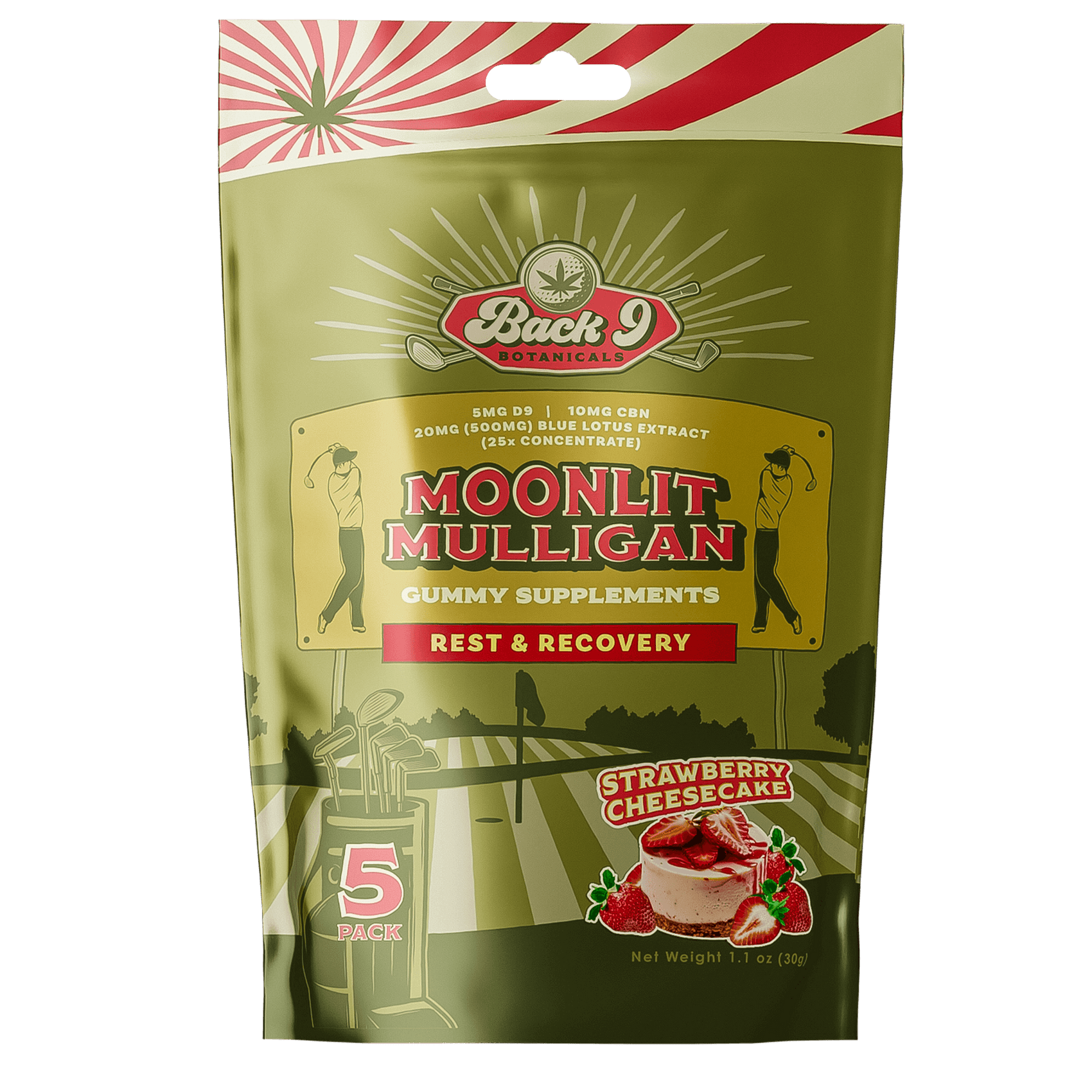
Our Performance Canna+ Gummies bundle includes three targeted blends: Birdie Boost for pre-round focus and calm confidence, Players Blend for mid-round energy and presence, and Moonlit Mulligan for post-round recovery and restorative sleep.

Each blend uses precise doses of hemp-derived cannabinoids and natural botanicals to support your specific need at that moment.
Putting It All Together: Your Complete Round Strategy
Anxiety management isn't a single technique, it's a system: prepare before the round, manage pressure during play, and recover after. Each phase builds on the last.
Before your round
Start your anxiety management before you arrive at the course.
- Sleep well: Poor sleep amplifies anxiety. Aim for 7-9 hours the night before
- Eat and hydrate: Low blood sugar increases anxiety. Eat a balanced meal 2-3 hours before play
- Arrive early: Don't rush. Give yourself 30-45 minutes to settle in
During play
On the course, your job is simple: execute your pre-shot routine and trust your preparation.
- Use your routine: Same routine for every shot, no exceptions
- Breathe between shots: Use diaphragmatic breathing or box breathing if anxiety rises
- Stay present: Focus on the current shot, not the score or what's ahead
After your round
Recovery after play sets up your next performance.
- Reflect without judgment: Notice what went well and what was hard, without criticism
- Move and stretch: Light walking or stretching releases residual tension
- Hydrate and eat: Replenish what you've used
Golf performance anxiety is manageable. It doesn't require fearlessness or eliminating pressure, it requires a system that keeps you calm, focused, and committed when it matters.
The techniques in this guide, breathing exercises, pre-shot routines, pressure practice, and recovery support, work together. Start with one or two and add more as they become automatic. Most golfers see meaningful improvement within 4-6 weeks of consistent practice.
If you're ready to support your mental game with targeted recovery, try our Performance Canna+ Gummies bundle designed specifically for golfers. Each blend supports a different phase of your round: Birdie Boost for pre-round calm confidence, Players Blend for mid-round focus and energy, and Moonlit Mulligan for post-round recovery and sleep.

Frequently Asked Questions
What is the 3-3-3 rule for anxiety, and can it help golfers?
The 3-3-3 rule is a grounding technique: identify 3 things you see, 3 things you can touch, and 3 things you hear. For golfers, this refocuses your attention on the present moment rather than future outcomes or past mistakes. Use it on the tee box or before a crucial putt to anchor yourself to your surroundings and calm racing thoughts that fuel performance anxiety.
How can I calm my nerves before a round of golf?
Arrive early to warm up and acclimate to the course. Practice your pre-round routine on the range, focusing on rhythm and tempo rather than mechanics. Use deep breathing, try box breathing (4 counts in, hold 4, out 4, hold 4) for 2-3 minutes. Many golfers also benefit from a consistent pre-round ritual: a light meal, hydration, and a few moments of visualization of successful shots to build confidence before you play.
How can I stop overthinking my golf swing?
Overthinking usually stems from dwelling on mechanics or past mistakes. Shift your focus to a single swing thought or target. Trust your preparation and commit fully to each shot. During your pre-shot routine, pick your target, take one practice swing, and execute without hesitation. If doubt creeps in, use a trigger word (like "trust" or "commit") to redirect your mind to the present moment and the shot at hand.
Can I use natural wellness support alongside my mental game techniques?
Yes. Many golfers combine mental skills training with recovery and wellness routines to manage overall stress and tension. Products like Back 9 Botanicals' Players Blend ($19.99) provide energy and focus support with caffeine and L-citrulline before a round, while Moonlit Mulligan ($10.99 per pack) supports post-round relaxation and sleep. Always consult with a healthcare provider before starting any new supplement, especially if you take other medications or have health concerns.

