
 Cart (0 items)





New to CBD? This cbd dosing guide for beginners covers how much to take, timing, and what to expect. Learn to find your ideal serving size.
CBD Dosing Guide for Beginners: How Much to Take

Table of Contents
- What Is CBD and How Does It Work in Your Body?
- How to Calculate CBD Dosage by Body Weight
- Start Low and Go Slow: A Beginner's Titration Plan
- CBD Oil Dosage for Sleep and Recovery
- Does CBD Show on Drug Tests?
- Tracking Your Progress: A Daily Dosing Log
- Common Mistakes Beginners Make With CBD Dosing
- Conclusion
- Frequently Asked Questions
Last Updated: September 15, 2026
What Is CBD and How Does It Work in Your Body?
CBD, or cannabidiol, is a hemp-derived cannabinoid that interacts with your body's endocannabinoid system, a signaling network that helps regulate sleep, stress, and recovery. Unlike delta-9 THC, CBD does not produce a euphoric high, which is why it has become a staple for athletes and weekend warriors managing soreness and nerves. This cbd dosing guide for beginners starts with the basics because dose decisions only make sense once you understand how cannabidiol moves through the body.
The endocannabinoid system works to maintain homeostasis, and CBD appears to influence it indirectly rather than locking onto receptors the way THC does. This matters for dosing because the effects build gradually. Full-spectrum products carry trace cannabinoids and terpenes that may shape the experience, while isolate delivers cannabidiol alone.
At Back 9 Botanicals, we build full-spectrum formulas around this principle, pairing CBD with supporting botanicals for focus, recovery, and rest.
How to Calculate CBD Dosage by Body Weight
A reasonable starting point for CBD dosage by body weight is roughly 1 to 2 milligrams per 10 pounds of body weight per day, split into one or two servings (NCCIH). A 180-pound adult would begin somewhere between 18 and 36 milligrams daily, then adjust from there. That is a starting range, not a target to hit on day one.
Why Metabolism and Body Composition Matter More Than Weight Alone
Body weight is only one input. Metabolism, body composition, and individual pharmacokinetics change how quickly you process a cannabinoid, and so does the delivery method. This is why two people of identical weight can respond very differently to the same number of milligrams.
The practical takeaway: treat any weight-based formula as a baseline, then let your own response set the final number. Consistency in serving size and concentration matters more than precision on paper.
Why 10 mg of Oil Is Not the Same as 10 mg of a Gummy
This is the single biggest source of beginner confusion, and most dosing guides skip it entirely. The milligram number on the label tells you how much cannabidiol is in the product, it does not tell you how much actually reaches your bloodstream. That difference is called bioavailability, and it varies widely by delivery method.
- Sublingual tincture (held under the tongue): Absorbs through the thin tissue under the tongue and bypasses the digestive system, so a larger share of the dose reaches circulation and effects typically begin within 15 to 45 minutes.
- Edibles and gummies: Must pass through the stomach and liver, where a portion of the cannabinoid is broken down before it reaches circulation. Onset is slower, often 30 minutes to 2 hours, but effects tend to last longer.
- Capsules: Behave much like edibles, since they also travel through digestion. Onset and duration are similar, though absorption can vary with whether you have eaten.
- Topicals: Act locally at the application site and are not intended to produce systemic effects, so they are not dosed the same way as an oil or edible.
A common pattern is that people who switch from a tincture to a gummy at the same milligram count feel less effect, then assume the product is weak. In reality they changed the delivery method without changing the number. If you switch formats, treat it as a fresh start and re-titrate from a lower point rather than carrying your old dose over.
Key Takeaway
Milligrams measure what is in the bottle, not what reaches your bloodstream. When you change delivery methods, change your starting dose too, then rebuild from there.
NIH National Center for Complementary and Integrative Health overview of cannabidiol
Start Low and Go Slow: A Beginner's Titration Plan
Titration is the practice of starting at a low dose and increasing it in small increments until you reach your therapeutic window, the range where benefits appear without unwanted effects. For most beginners, that means beginning at the low end of your calculated range and holding there for several days before changing anything. Patience during this adjustment period establishes the steady foundation necessary for starting a supplement routine that remains sustainable and effective over the long term.
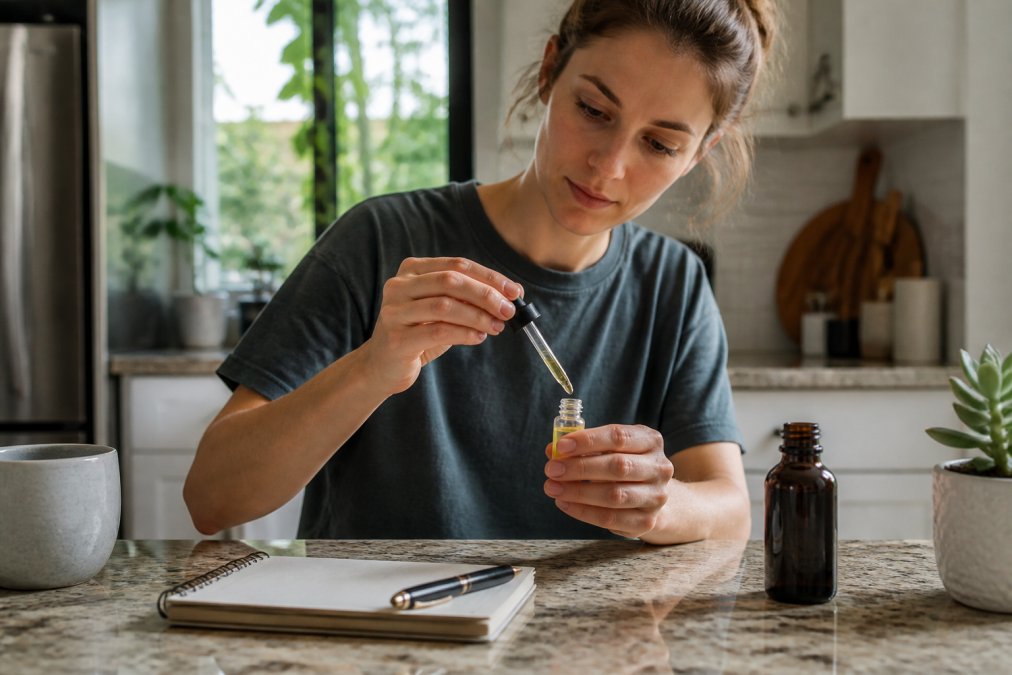
A workable beginner schedule looks like this:
- Days 1-3: Start at the lowest end of your range, once daily.
- Days 4-6: If you feel nothing, add a small increment, roughly 5 milligrams.
- Days 7-10: Hold at the level where you notice an effect, then stop increasing.
- Ongoing: Adjust only one variable at a time, and only every few days.
Watch Out
The most common beginner mistake is doubling the dose after one day because "nothing happened." Edibles in particular can take a couple of hours to register, so stacking doses too quickly is how people overshoot and end up uncomfortable.
CBD Oil Dosage for Sleep and Recovery
For sleep and recovery, a common starting range is 10 to 25 milligrams taken 30 to 60 minutes before bed, though some people do better with a smaller daytime serving for muscle soreness (pubmed.ncbi.nlm.nih.gov). The right number depends on your symptom, your delivery method, and how your body handles cannabinoids.
Symptom-Specific Starting Ranges
Symptom-specific dosing is where most generic guides stop short, but it is the detail that makes a real difference. These are starting points, not prescriptions:
| Goal | Typical Starting Range | Timing | Notes |
|---|---|---|---|
| Sleep support | 10-25 mg | 30-60 min before bed | Pair with CBN for rest |
| Muscle recovery | 10-20 mg | Post-activity | Split across the day if needed |
| Stress and nerves | 5-15 mg | As needed | Lower doses often suffice |
| Daily balance | 10-20 mg | Once daily | Consistency matters most |
A tincture held under the tongue tends to offer faster onset than an edible, while edibles deliver longer-lasting effects. Match the delivery method to the goal.
Dosing for Sleep vs. Stress vs. Soreness
The three goals behave differently, and treating them as one number is why so many beginners feel like nothing is working.
- Sleep: Take your serving 30 to 60 minutes before bed and keep it consistent night to night. Sleep support tends to build over several days rather than working on the first night, so give a steady dose at least a week before judging it.
- Stress and nerves: Lower doses often outperform higher ones here. A small serving earlier in the day, before a known stressor, tends to work better than a large serving after the fact.
- Soreness and recovery: Timing matters more than size. A serving taken within an hour or two after activity is the common pattern, with a second smaller serving later in the day if needed.
If you are chasing more than one goal, do not stack three separate doses on day one. Pick the goal that matters most, titrate that one, then add the second once the first is stable.
What to Do When Your Dose Stops Working
This is the question almost no beginner guide answers: what happens when a dose that worked for months quietly stops doing anything.
A few practical habits make tolerance easier to manage:
Watch Out
Do not treat a fading effect as a signal to double your dose. Escalating quickly is how beginners overshoot, and it makes the eventual reset harder to judge.
Does CBD Show on Drug Tests?
Tracking Your Progress: A Daily Dosing Log
A basic log entry looks like this:
Pro Tip
Log your dose before you take it, not after. People consistently overestimate how much they took when they write it down later, and that skews the one data set you actually control.
Common Mistakes Beginners Make With CBD Dosing
Conclusion
Frequently Asked Questions
How much is 1 dropper of CBD oil?
A standard dropper holds about 1 milliliter of oil, but the milligrams of CBD in that dropper depend on the bottle's concentration. A 30 mL bottle with 1,500 mg total contains roughly 50 mg per full dropper, while a 500 mg bottle holds about 16 mg per dropper. Always check the label for total milligrams and serving size before you measure your first dose.
Will 5 mg of CBD do anything?
For some beginners, 5 mg is enough to notice a subtle calming effect, especially for mild stress or as a starting point in a titration plan. Others feel nothing at that level and need to increase gradually. The only way to know is to start at 5 mg, hold that dose for several days, and track how you feel before adjusting.
How long does it take for CBD to start working?
Sublingual tinctures typically produce effects within 15 to 45 minutes because the cannabinoids absorb through tissue under the tongue. Edibles and gummies take longer, often 30 minutes to 2 hours, since they pass through digestion. Bioavailability differences between delivery methods mean onset time and intensity can vary widely from person to person.
Can you take too much CBD?
CBD has a favorable safety profile, but taking too much can cause drowsiness, dry mouth, or digestive upset. More importantly, high doses of CBD can interact with medications processed by the liver, including blood thinners and anti-seizure drugs. If you take prescription medication, check with your doctor before starting a daily regimen.
Does CBD show on drug tests?
Full-spectrum CBD products may contain trace amounts of delta-9 THC, which can accumulate with daily use and potentially trigger a positive result on a drug test. Isolate-based products carry lower risk but are not guaranteed THC-free. If you are subject to testing, choose products with third-party lab results and discuss the risk with your employer or testing authority.
How do I know when to increase my CBD dose?
Stay at your starting dose for at least 5 to 7 days before increasing. If you feel no change after that window, add 5 mg and hold again. Keep a daily log noting dose, timing, and how you feel. The goal is to find the lowest dose that produces the effect you want, not the highest dose you can tolerate.

